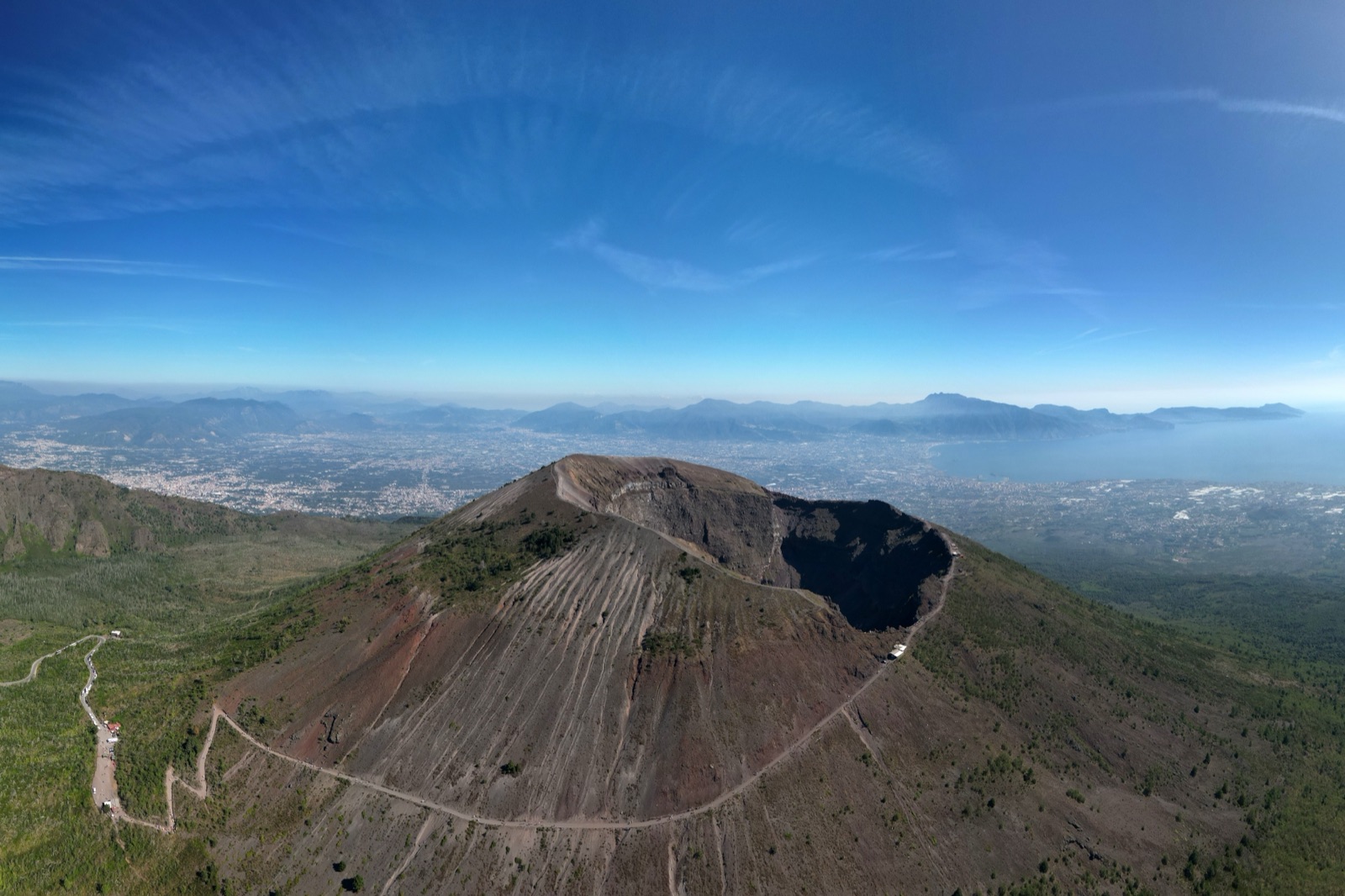
Vesuvius National Park: What to See Beyond the Crater
Vesuvius National Park protects the volcano and the old Monte Somma around it: 8,482 hectares across 13 municipalities in the province of Naples, established on 5 June 1995. Most visitors see only one part of it, the crater path from the square at 1,000 m above Ercolano, which needs a timed online ticket. But the park also has 11 numbered trails, a forest reserve, the museum of the Osservatorio Vesuviano, the world’s first volcano observatory, its own park museum at Boscoreale, and wildlife and plants you will not see from the rim. This guide explains what is in the park, how each part works for visitors, and how to fit more than the crater into a visit.
The park at a glance
- Established: 5 June 1995, to protect the only active volcano of continental Europe.
- Area: 8,482 hectares in 13 municipalities.
- Highest point: the Gran Cono, 1,277 m by the park’s geology page (1,281 m on its map).
- Trails: 11, with 54 km of walkway by the park’s trail count.
- Headquarters: Palazzo Mediceo in Ottaviano.
- The crater: trail 5, the Gran Cono, by timed online ticket only.
- Free trails: the Tirone reserve trail, the Strada Matrone and the Vallone della Profica have free access.
What the park protects
The park is more than a volcano. Besides the Gran Cono, it includes two Sites of Community Importance, a Special Protection Zone, a wilderness area in the Somma caldera, the Tirone-Alto Vesuvio forest reserve of about 1,000 hectares, and the Somma-Vesuvio and Miglio d’Oro biosphere reserve.
The 13 park municipalities are Boscoreale, Boscotrecase, Ercolano, Massa di Somma, Ottaviano, Pollena Trocchia, San Giuseppe Vesuviano, San Sebastiano al Vesuvio, Sant’Anastasia, Somma Vesuviana, Terzigno, Torre del Greco and Trecase. The park also keeps a calendar of religious festivals and traditions of coral, lava stone and copper craftsmanship, which are part of what it protects.
For where all this sits on the map, see where is Vesuvius?.
The landscape: a volcano inside a volcano
The park’s centre is the complex the geologists call Somma-Vesuvius:
- The Gran Cono, a truncated cone whose crater is about 450 m across and 300 m deep, with small fumaroles that show its state of “active rest”.
- Monte Somma, the older volcano, reaching 1,132 m at Punta Nasone and about 15 km across at its base, an arc open to the south around the cone, with a crest of rock spurs called cognoli.
- The Valle del Gigante between the two, divided into the Valle dell’Inferno to the east and the Atrio del Cavallo to the west, covered by the lava flows of recent centuries.
The slopes of Somma hold some of the wildest parts of the park: mixed woods of chestnut, robinia, birch, Neapolitan maple and Neapolitan alder.
The Gran Cono: the crater path
The crater visit follows trail 5, the Gran Cono, from the square at 1,000 m in Ercolano, at the end of the Ercolano-Vesuvio provincial road. It is the one part of the park with a ticket.
- Tickets only online. For each day 50 tickets every 10 minutes go on sale thirty days ahead, and when a slot sells out, 10 last-minute tickets are released, bought only over the wi-fi near the entrance.
- Prices. The park lists a full ticket at €10.00 and a reduced one at €8.00 before booking fees; on the ticket site they cost €11.68 and €9.55.
- Reduced tickets are for residents of the 13 park municipalities and young people under 25, with ID.
- Children under 6 go free with an accompanying adult, with ID showing their age.
- Hours. Visits start at 9:00; the last entry runs from 15:00 in winter to 18:00 in July and August, and the visit must end within an hour of the last entry.
- On the square there is no parking and, for now, no public toilets.
Everything about booking is in the crater ticket guide, and the ways up are in getting to Vesuvius.
Beyond the crater: the trail network
The park built its network in 2001-2003. Its trails include six circular nature trails, an educational trail, a panoramic trail and an agricultural trail, spread around the mountain from Ottaviano to Ercolano and Terzigno. The highlights:
- Trail 1, the Valle dell’Inferno, from Ottaviano: 12,390 m return, about 7 hours.
- Trail 3, Monte Somma, to Punta Nasone: 7,650 m return, about 5 hours.
- Trail 4, through the Tirone reserve: open Saturday and Sunday, 9:00 to 16:00, free, with park guides.
- Trail 6, the Strada Matrone, from Trecase up to the Gran Cono: free, open on the crater’s hours.
- Trail 9, the Fiume di Lava: a 1-hour walk onto the 1944 lava flow near the Osservatorio.
- Trail 11, the Terzigno pine wood: a 30-minute level boardwalk designed for people with reduced mobility.
Some trails and sections are closed for maintenance, and some may lack signs; the park asks walkers to contact it for current information. Full details are in the hiking trails guide.
Plants of the park
The volcano has been colonised over its history by more than 1,000 plant species, counting those now extinct. Today’s flora counts 744 taxa, of which only 2%, fifteen, are endemic, probably because eruptions have wiped the slate clean so many times. Things to look for:
- Broom. Three kinds grow here, including Etna broom, introduced to Vesuvius after the 1906 eruption, which forms impenetrable thickets in the Atrio del Cavallo and the Valle dell’Inferno.
- Orchids. The flora includes 19 species of wild orchid, protected for their rarity, flowering in spring in the woods.
- Birch. Small relict groups survive from cooler, wetter times.
- The silver lichen. The 1944 lava flows are coloured silvery grey by the pioneer lichen Stereocaulon vesuvianum.
- Fungi. More than 200 species of fungi grow in the park.
Animals of the park
Surrounded by towns, the park has become what its naturalists call a biogeographical island, but it still holds a rich community of animals. Recorded vertebrates include 2 amphibian species, 8 reptile species, 138 bird species and 29 mammal species, plus 44 species of day-flying butterflies.
- Cliff birds such as the raven, the peregrine falcon and the rock thrush live among the lava walls of the Valle dell’Inferno.
- Woodpeckers drum in the mixed woods above Ottaviano.
- The golden oriole arrives in summer in the orchards and vineyards of the eastern slopes.
- The Aesculapian snake, large but harmless, lives in the Tirone woods.
- Rare bats, including the greater horseshoe bat, breed in the attics of Palazzo Mediceo.
The park is also an important stopover and refuge for migrating animals, being the only high ground in the middle of the plain.
The Osservatorio Vesuviano museum
On Colle del Salvatore, on the western side of the volcano, stands the Osservatorio Vesuviano, founded in 1841 by Ferdinand II of Bourbon and described by INGV as the first volcanological observatory in the world. Research moved to Naples long ago, and the historic building is now a museum.
Inside you find scientific instruments, rocks and minerals, books some dating back to the 1500s, gouaches from the 1700s and seismic recordings on paper from 1915 to 1970. The seismographs designed by Luigi Palmieri and others are the heart of the collection, and the building has two sundials and large terraces with views over the Gulf of Naples.
How visits work:
- Free, Monday to Friday; weekend visits are temporarily suspended except for institutional events.
- Guided, in Italian or English, about an hour, in shifts of two groups of at least 10 and at most 25 people.
- Booked by email in advance; shifts start at 09:30, 11:30, 13:30 and 15:30, plus 17:00 when summer time is in force.
- Punctuality: up to 30 minutes’ delay is allowed; cancellations must be emailed at least 24 hours ahead.
Because groups have a minimum of 10, couples and small families may need to ask about joining another group. The short trail 9 to the 1944 lava starts nearby, so the two fit together well.
The park museum at Boscoreale
The Vesuvius National Park museum is in the Villa Regina cultural centre in Boscoreale, set up with the Comune di Boscoreale, the Osservatorio Vesuviano-INGV and the Fondazione Cives. It has five rooms: the volcano and its eruptions, with a model of the cone; the birth of Vesuvian soils; soil and biodiversity; damage from misuse of the land; and the relationship between people and Vesuvius, with a model of a farmhouse making wine.
- Open Friday, Saturday and Sunday, 10:00 to 16:00 (last entry).
- Booking is compulsory, by email, and each slot admits at most 30 visitors.
Archaeology in and around the park
The park’s own pages put the Roman sites at the heart of the Vesuvius story:
- Herculaneum, on the UNESCO list with Pompeii and Oplontis since 1997, was discovered by chance in 1709. See the Herculaneum article.
- Pompeii, south-east of the volcano. The Pompeii+ ticket covers the ancient city with the suburban villas, Villa Regina in Boscoreale with its Antiquarium, and the shuttle bus.
- The Antiquarium and Villa Regina at Boscoreale open at 9.00, with last entrance at 16.00 in winter and 18.00 from 16 March to 14 October. On their own, Boscoreale, Oplontis and the Archaeological Museum of Stabiae each cost €8.00.
- The MAV in Ercolano, a virtual archaeology museum with more than seventy multimedia installations; €10.00 for an adult.
Villa Regina is convenient: the park museum and the Roman site are in the same place, so one stop covers both.
Rules in the park
The rules are short, and the park has its own Carabinieri unit:
- No fires and no litter.
- No disturbing or hunting animals, and no collecting minerals or plants.
- Stay on the marked paths.
- No camping or bivouacking, and no motor vehicles on the trails.
The park also reminds visitors that it has no remit for safety: take great care, check the weather, and wear suitable shoes.
Planning a visit to the park
A few practical points help:
- Start from Ercolano if the crater is your priority: the square at Quota 1000, the Osservatorio and trail 9 are all on that side.
- Check the weather. In strong wind, rain or snow the crater path may close, and ice or an alert can close the road. See the Vesuvius weather page.
- Bring what you need. Facilities on the mountain are few; the crater square has no public toilets at present.
- Plan transport. Buses and shuttles serve the crater path; the other trailheads usually need a car or taxi.
History on the slopes: roads, railways and lava
The park is also a museum of how people have reached the crater over the last century and a half, and of what the volcano did to their efforts.
- The rack railway and the funicular. From 1903 a railway carried tourists from Pugliano, in Ercolano, to the lower station of the funicular, the line made famous by the song Funiculì funiculà. The 1944 eruption destroyed the funicular; it was replaced in 1953 by a chairlift, which closed in 1984 because wind often made it unusable. The little train made its last run in 1955, when the road from Ercolano up to Quota 1000 was finished. Trail 8 follows part of its route from San Sebastiano.
- The Strada Matrone. The Matrone brothers’ road up the Trecase side opened as a carriage road on 4 January 1927 after almost thirty years of work and repeated destruction by lava. It is now trail 6, a free walking and cycling route to the Gran Cono.
- The 1944 lava. The last eruption emitted 21 million cubic metres of lava and sent ash as far as Albania. Its flows still fill the Atrio del Cavallo and can be walked on trail 9, a short path from the Osservatorio.
Palazzo Mediceo in Ottaviano
The park’s headquarters is a building with a story of its own. Palazzo Mediceo in Ottaviano, owned by the Medici from 1567, later fell into the hands of organised crime, was confiscated by the state and returned to the town. It now houses the park authority and an environmental education centre. Its historic gardens hold centuries-old sequoias and yews, and its attics shelter breeding colonies of rare bats. You pass it on the road up to the start of trails 1 and 2, 4 km from the centre of Ottaviano.
Three ways to spend a day in the park
- Crater and observatory (weekday): a morning crater slot, then trail 9 and a booked Osservatorio visit, all on the Ercolano side.
- Hiking day: trail 1 from Ottaviano, starting early, with a look at Palazzo Mediceo on the way up.
- Volcano and ruins: the crater in the morning, then Pompeii or Herculaneum, or a Friday-to-Sunday visit to the park museum and Villa Regina at Boscoreale. Tours from Naples and Pompeii combine the crater with the ruins.
Frequently asked questions
Is Vesuvius a national park?
Yes. Vesuvius National Park was established on 5 June 1995 and covers 8,482 hectares across 13 municipalities.
Do you have to pay to enter Vesuvius National Park?
The crater path, trail 5, needs a ticket: €10.00 full and €8.00 reduced before fees, bought online. Trails such as the Tirone reserve and the Strada Matrone are free.
What is there to do in Vesuvius National Park?
The crater path, 11 trails including the Valle dell’Inferno and Monte Somma, the Osservatorio Vesuviano museum, the park museum at Boscoreale, and Roman sites around the volcano.
Can you visit the Vesuvius Observatory?
Yes, free, Monday to Friday, by email booking, in guided groups of 10 to 25 people.
What animals live on Vesuvius?
Among others, 138 bird species including peregrine falcons and ravens, 29 mammal species, 8 reptile species and 2 amphibian species.
Where is the Vesuvius National Park museum?
In the Villa Regina cultural centre at Boscoreale, on the south side of the volcano. It opens Friday to Sunday, 10:00 to 16:00, by email booking, with at most 30 visitors per slot.
Can you walk in Vesuvius National Park without a guide?
Yes, on the open trails, as long as you stay on the marked paths. Trail 4 in the Tirone reserve has park guides on the trail at weekends, and the crater path is self-guided with a timed ticket. Because some trails may lack signs, take a downloaded map and ask the park about current closures.
When is the best time to visit the park?
Spring for flowers and birds, and September for long dry days. See the best time to visit Vesuvius for the month-by-month picture.