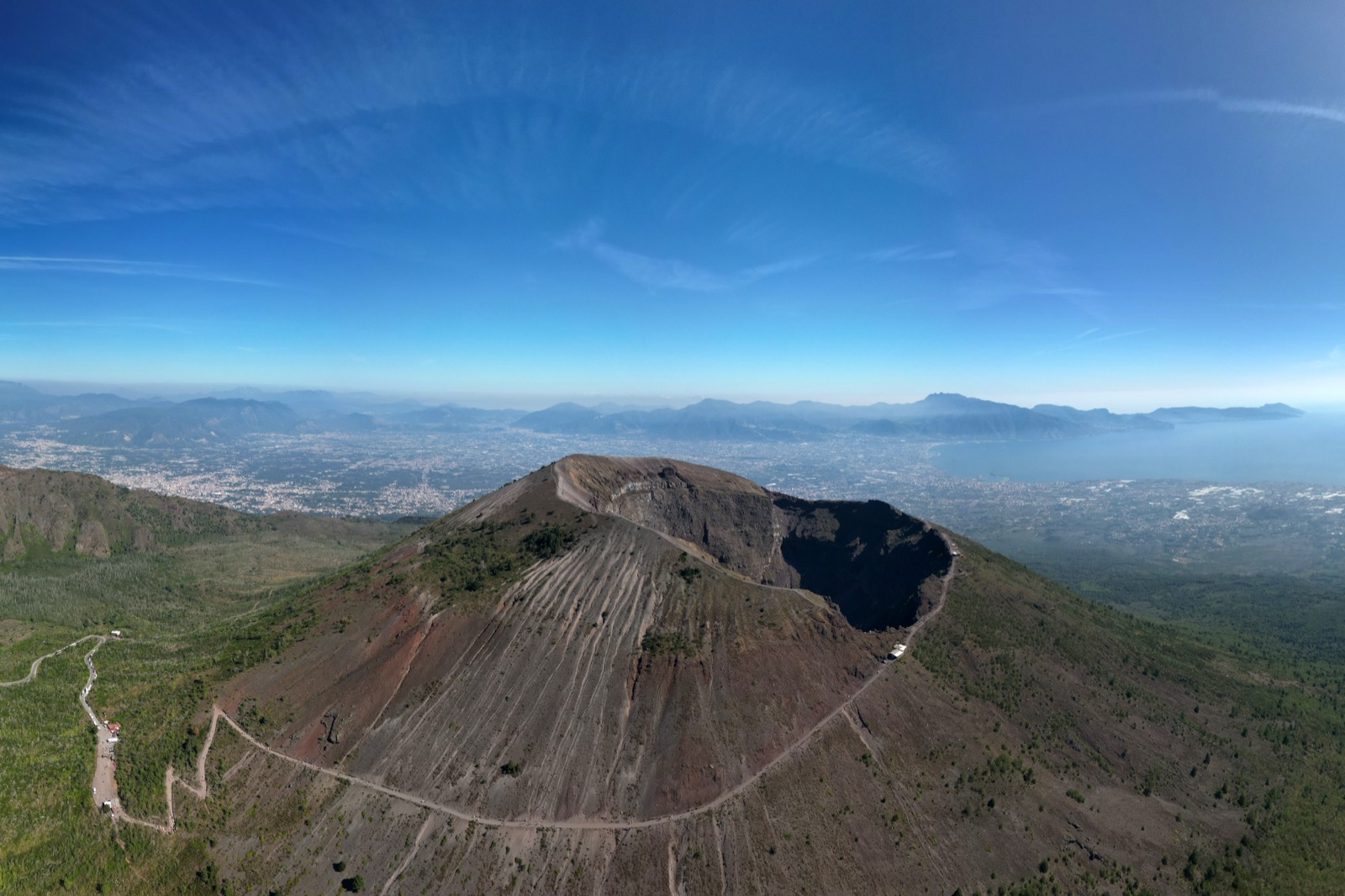
How to Get to Vesuvius: Bus, Train, Car or Tour
Getting to the top of Vesuvius is not one journey but two. First you have to reach the foot of the volcano — Naples, Ercolano, Pompeii or Sorrento — and then you have to get from there up to the car parks near the crater path, where your timed ticket starts. There is no railway to the top and no public transport from central Naples straight to the path, so the second leg is where most of the planning goes.
This guide covers every way of doing it: the public bus from Pompeii, the private shuttle from Ercolano, driving yourself and parking, and the transfers and tours that do it all for you.
The one thing to sort out before you travel
Whichever way you go, book your crater ticket first. Crater tickets are sold only online, on the park’s ticketing site, and entry is in groups of 60 visitors every 10 minutes. The mobile signal near the entrance is very weak, so you cannot count on buying one when you arrive. Our guide to crater tickets and the Gran Cono path covers the ticket rules in detail.
The reason this matters for transport: your ticket has a time on it. You may enter up to 120 minutes before or after that time, which gives you a comfortable window, but your bus, shuttle or drive needs to land you inside it.
Where you are actually going
The crater visit follows path no. 5 of the national park, the Gran Cono. Its main access is the Piazzale di Quota 1000 in Ercolano, a square at about 1,000 m on the mountain’s western side (the names up here are altitudes). You cannot park at the square itself: drivers use the parking areas lower down the provincial road, run by the Comune di Ercolano, and transfer up. Buses and shuttles go to the top. Everything in this guide is about getting you to that square.
| Option | Starts from | Gets you to | Good for |
|---|---|---|---|
| EAV bus 808 | Pompeii | Quota 1000, at the path entrance | Travellers staying in or passing through Pompeii |
| Vesuvio Express | Ercolano station square | The entrance at 1,000 m | Travellers arriving by train at Ercolano Scavi |
| Your own car | Anywhere | Parking below, then shuttle or walk | Flexibility, early starts |
| Transfer or tour | Naples, Pompeii, Sorrento | The path entrance | No planning, often with the ticket included |
By public bus: EAV line 808 from Pompeii
The public option is EAV bus line 808, which runs from Pompeii up to the Vesuvio Quota 1000 car park, right at the start of the crater path. On the way it stops near the Torre del Greco motorway exit and several times in Ercolano.
- Journey time: about 55–70 minutes from Pompeii.
- Frequency: roughly every 60–120 minutes, depending on the time of day.
That frequency is the thing to plan around. With a bus every hour or two, your crater time slot and the bus timetable need to be matched before you set off, not after. Look up the current timetable, pick the bus that gets you to the top comfortably inside your ticket window, and note the return times before you start walking.
One important detail: bus 808 does not stop at Ercolano Scavi station. If you arrive in Ercolano by train, the bus is not your option; the private shuttle is.
Getting to the bus from Naples and Sorrento
- From Naples: take the Circumvesuviana train to Pompei Villa dei Misteri, then bus 808.
- From Sorrento: take the Circumvesuviana to Pompei Villa dei Misteri, then bus 808.
By private shuttle: the Vesuvio Express from Ercolano
If you come by train and get off at Ercolano Scavi, the alternative is the Vesuvio Express, a private shuttle that leaves from the station square in Ercolano and takes visitors directly to the entrance at 1,000 metres.
- From Naples: take the Circumvesuviana to Ercolano Scavi, then the Vesuvio Express up.
This is often the most convenient route from central Naples, because Ercolano is the closer of the two train stops, and it pairs well with a visit to the ruins of Herculaneum on the same day.
By car: driving and parking
Driving gives you the most freedom, especially if you want to be there when the first slots open or to fit Vesuvius around other stops.
Where to park
Parking for the crater is between the Quota 800 junction and the chairlift square, and it costs €7 for a car. From the Quota 800 car park you reach the path entrance on foot or by shuttle.
The shuttle from the car park
The shuttle from the car park up to the crater entrance is run by the Comune di Ercolano. Two rules to know:
- Have your crater ticket before you board the shuttle. You will not be allowed to continue without it.
- Buy the crater ticket before the parking ticket. Crater entry is capped, and your preferred time may already be gone; there is no point paying for parking and the shuttle for a slot you cannot get.
Walking up from Quota 800
If you prefer to walk from the car park, you can. It adds time and effort before you even reach the start of the crater path, so factor it into your ticket window — and remember that the crater walk itself is about 3 hours there and back.
Transfers and tours: when they make sense
If matching trains, buses and ticket slots sounds like more planning than you want, a transfer or tour does it for you. The main types:
Transfer with park entry from Pompeii. An air-conditioned minibus from a central meeting point in Pompeii to the volcano, with the national park ticket included. You walk to the crater at your own pace. About 3 hours in total.
Transfer and entry from Pompeii or Naples. A bus up to about 1,000 m, then the walk to the crater and along its rim, departing from Pompeii or Naples, with the entry ticket included. Also about 3 hours.
Crater ticket with a digital guide. If you are driving or taking the bus yourself, this is the skip-the-line entry to the crater path with a smartphone audio guide. Getting to the car park is up to you.
Day trips that combine Vesuvius with Pompeii or Herculaneum. From Naples, a round-trip bus covers the crater walk and then Pompeii’s ruins with an audio guide in about 6 hours. A longer day adds Herculaneum as well, in 7.5–8.5 hours. From Sorrento, a small-group trip with pickup from your accommodation, a guided tour of Pompeii and lunch takes about 8 hours. Our guide to Vesuvius and Pompeii in one day compares them.
The practical advantage of a transfer or tour is not only the transport. Many of them include the crater ticket, which removes the hardest part of the planning: getting a slot and then getting to it on time.
Arriving at the top
However you get there, the last few minutes are the same. You arrive at the Piazzale di Quota 1000, the access point for path no. 5, and go through an automatic gate at the time on your ticket (give or take the 120-minute window either side). From the gate, the path climbs to the crater rim and follows part of it before you turn back: 3,807 m in total, topping out at 1,170 m, with about 140 m of climbing at an average gradient of 14%. Allow about 3 hours there and back, and more if you like to stop for photographs.
Because the square is the end of the line for buses and shuttles, it is also where you catch your ride down. Before you set off up the path, check when your bus or shuttle leaves and make sure the walk fits comfortably before it.
Three sample days
The details change with the timetables, but the shape of each route is worth seeing laid out.
From Naples by train and the Vesuvio Express
Take the Circumvesuviana from Naples to Ercolano Scavi. From the station square, the Vesuvio Express takes you to the entrance at 1,000 m. Walk the crater path, come down on the shuttle, and — if you still have energy — visit the ruins of Herculaneum in Ercolano before taking the train back to Naples. It is a full, satisfying day, and none of it requires a car.
From Pompeii by bus 808
Board bus 808 in Pompeii, allowing 55–70 minutes for the ride and choosing a departure that lands you inside your ticket window. Walk the path, then catch a return bus — with a bus only every 60–120 minutes, it is worth knowing the return times before you start. If you are staying in Pompeii, you can visit the ruins the day before or the day after and keep both days relaxed.
By car from anywhere in the area
Drive up the provincial road to the parking area between the Quota 800 junction and the chairlift square, and pay €7 for the car. Take the shuttle run by the Comune di Ercolano to the top (crater ticket in hand), or walk. The advantage is flexibility: you can arrive early, leave when you like and fit Vesuvius around Herculaneum, Pompeii or the coast.
If you are staying in Sorrento
Sorrento is at the far end of the Circumvesuviana line, which makes Vesuvius a longer day from there than from Naples or Pompeii — but a very doable one.
On your own, take the Circumvesuviana to Pompei Villa dei Misteri and change to bus 808. The train ride is the long part; the bus then climbs the mountain in about 55–70 minutes. Because both legs have their own timetable, this is the route where it pays most to plan the whole day in advance, including the return train.
With a tour, the day is simpler. The small-group trip from Sorrento picks you up from your accommodation by van, includes a two-hour semi-private guided tour of Pompeii and lunch at a local osteria, and visits Vesuvius National Park, in about 8 hours. If you are travelling with children or would rather not juggle trains, buses and ticket slots, that simplicity is worth a lot.
Either way, start early. The longer your journey to the foot of the mountain, the less room you have if a train runs late or a bus is full.
Combining Vesuvius with Herculaneum or Pompeii
The two great Roman sites buried by Vesuvius sit at its foot, and the transport routes up the mountain start near both.
- Herculaneum is the natural pairing if you come by train to Ercolano Scavi and take the Vesuvio Express. The ruins are compact, so a morning on the volcano and an afternoon among the ruins works well.
- Pompeii pairs with bus 808, which starts there. Pompeii is much larger than Herculaneum, so if you want to see it properly, give it most of a day on its own or choose a combined tour that plans the timing for you.
Who should think twice
The crater path is a steady climb on loose volcanic gravel, not a stroll. The park’s own advice is that the climb is not recommended for people with complex respiratory or cardiovascular conditions. If that applies to anyone in your group, the views from the lower slopes and the ruins at the foot of the mountain are a good alternative, and some combined tours let part of a group skip the crater while the others walk.
Which option to choose
- Staying in Pompeii: bus 808 or a transfer with park entry from Pompeii.
- Staying in Naples, travelling by train: Circumvesuviana to Ercolano Scavi and the Vesuvio Express, or to Pompei Villa dei Misteri and bus 808.
- Staying in Sorrento: Circumvesuviana to Pompei Villa dei Misteri and bus 808, or a day trip with pickup.
- Driving: park at Quota 800 for €7, crater ticket bought first.
- You want no planning at all: a transfer or tour with the ticket included.
Tips for the journey
- Build in slack. The ticket window is generous, but a bus every hour or two is not. Aim to arrive early in your window rather than late.
- Check the weather before you leave. During a weather alert issued by the civil protection of the Campania Region, access to the path may be closed. If it is, a ticket bought on the park’s site is refundable — refunds are given only if the path is closed for bad weather or force majeure.
- Take a layer. In autumn and winter it is colder at the crater than at the foot of the volcano, and the wind can rise suddenly.
- Know your limits. The climb is not recommended for people with complex respiratory or cardiovascular conditions.
Frequently asked questions
Can you get to Vesuvius by public transport?
Yes. EAV bus 808 runs from Pompeii to the Quota 1000 car park at the start of the crater path, in about 55–70 minutes, roughly every 60–120 minutes. From Naples or Sorrento, take the Circumvesuviana to Pompei Villa dei Misteri first.
Does bus 808 stop at Ercolano Scavi?
No. From Ercolano Scavi station the option is the private Vesuvio Express shuttle, which leaves from the station square and goes to the entrance at 1,000 metres.
How much is parking at Vesuvius?
Parking between the Quota 800 junction and the chairlift square costs €7 for a car. From there you walk or take the shuttle run by the Comune di Ercolano to the path entrance.
Do I need my crater ticket before I travel?
Yes. Tickets are sold only online, entry is capped at 60 visitors every 10 minutes, and the signal near the entrance is very weak. You also need your crater ticket before you board the shuttle from the car park.
What happens if I miss my time slot?
You may enter up to 120 minutes before or after the time on your ticket. Outside that window, the ticket is not valid, and tickets cannot be changed or cancelled.
Is there a train to the top of Vesuvius?
No. Trains stop at the foot of the volcano — Ercolano Scavi and Pompei Villa dei Misteri on the Circumvesuviana — and you continue by bus, shuttle, car or tour.