Best Time to Visit Vesuvius: Month by Month, Crowds and Closures
Mount Vesuvius weather this week
Gran Cono crater rim (1,170 m)
The five-day forecast for Gran Cono crater rim, updated through the day.
Forecast data from MET Norway (CC BY 4.0), summarised by day.
The best time to visit Vesuvius is April to June or September to October. In those months the crater path stays open until a last entry of 16:00 or 17:00, the long days leave room to add Pompeii or Herculaneum, and you avoid both the short winter hours and the July and August peak. Within any day, the first slots after 9:00 are the calmest way up. Winter visits work too, with fewer people, but the last entry is 15:00 and wind, ice or a weather alert can close the path at short notice.
This guide goes through the year month by month, explains what changes with the seasons, and shows how to fit the crater around the ruins.
The short answer
- Best overall: April, May, June, September and early October. Last crater entry 17:00 (16:00 in October), long days, spring flowers or autumn light.
- Longest days: July and August, with a last entry of 18:00, but the busiest period and the hottest walking.
- Quietest: November to February, with a last entry of 15:00 and the highest chance of a weather closure.
- Best time of day: the first slots from 9:00, or the last ones of the afternoon in summer.
- Whatever the month: book your timed ticket online, up to 30 days ahead, and check the Vesuvius weather page the day before.
How the season changes the crater path
The crater visit is the Gran Cono, trail 5 of the national park, from the square at Quota 1000 in Ercolano. Visits start at 9:00 all year, and what changes through the year is the last entry:
| Months | First entry | Last entry |
|---|---|---|
| January, February, November, December | 9:00 | 15:00 |
| March, October | 9:00 | 16:00 |
| April, May, June, September | 9:00 | 17:00 |
| July, August | 9:00 | 18:00 |
Two rules follow from that table:
- The visit must end within one hour of the last permitted entry. In winter that means you are off the path by about 16:00.
- The 120-minute window around your ticket does not stretch the day. You may enter up to 120 minutes before or after the time on your ticket, but never before 9:00 or after the last entry, and you must leave by closing time.
Capacity does not change with the season: entry is in groups of 60 visitors every 10 minutes, all year. So the busiest weeks simply sell out sooner, and quieter months give you more choice of slot.
Month by month
| Month | Crater last entry | Pompeii last entrance | What to expect |
|---|---|---|---|
| January | 15:00 | 15:30 | Short days, cold and windy at the top, closures more likely |
| February | 15:00 | 15:30 | As January; clear days can be superb |
| March | 16:00 | 15:30, then 17:30 from 16 March | Longer days return, weather still changeable |
| April | 17:00 | 17:30 | Spring flowers, Easter crowds |
| May | 17:00 | 17:30 | Broom in flower, a favourite month |
| June | 17:00 | 17:30 | Warm, long days, busier |
| July | 18:00 | 17:30 | Peak season, heat, latest crater entry |
| August | 18:00 | 17:30 | As July; book well ahead |
| September | 17:00 | 17:30 | Still long days, slightly cooler |
| October | 16:00 | 17:30, then 15:30 from 15 October | Autumn light, shorter afternoons |
| November | 15:00 | 15:30 | Quiet, short days, weather alerts possible |
| December | 15:00 | 15:30 | Quiet except holidays; Pompeii closed 25 December |
For temperatures, rainfall and a live forecast for the crater and the towns below, use the Vesuvius weather page.
Spring: March to June
Spring is the season most walkers would choose. From April the crater stays open until a last entry of 17:00, and Pompeii’s summer hours start on 16 March, with a last entrance at 17:30 and closing at 19:00. That makes a combined day relaxed rather than rushed.
It is also when the mountain looks its best:
- Late spring colour. The 1944 lava flow is grey for most of the year because of the lichen Stereocaulon vesuvianum, but in late spring it bursts into colour with flowering broom and red valerian.
- Orchids. The park’s flora includes 19 species of wild orchid; in spring they flower in the Tirone woods and beside the short lava-flow trail near the Osservatorio.
- Lilies on Monte Somma. In spring the orange lily flowers along the trail to Punta Nasone.
The catch is Easter and the spring holidays, when crater slots and Pompeii both fill up. Book as soon as your dates are fixed; tickets go on sale 30 days ahead.
Summer: July and August
Summer has the longest crater hours of the year, with a last entry of 18:00, and it is the time most visitors come. That brings three practical problems.
- Heat on an exposed path. The crater path climbs about 140 m at an average 14% gradient on loose volcanic ground with little shade. Go early, carry water and wear a hat.
- Sold-out slots. With 60 places every 10 minutes, mid-morning slots go first. If yours sells out, 10 last-minute tickets for each slot are released shortly before it starts, but they can be bought only over the wi-fi near the entrance, so do not plan around them.
- Crowds at Pompeii. From 16 March to 14 October Pompeii admits at most 15,000 visitors between 9:00 and 13:00 and 5,000 between 13:00 and 17:30, within a daily limit of 20,000.
The best summer plan is usually to split the day: crater first thing, Pompeii or Herculaneum in the afternoon, or the reverse with a late crater slot for the softer evening light. The Vesuvius and Pompeii in one day guide has sample timings.
Fire is a real risk on these wooded slopes in dry weather: the Strada Matrone trail was badly damaged by the fire of 2017. If the park closes a trail or an access for safety, the closure applies whatever your ticket says.
Autumn: September to November
September keeps the 17:00 last entry and is one of the best months of all: the summer crowds thin, the days are still long and the ground is dry.
October is a month of transition. The crater’s last entry moves to 16:00, and on 15 October Pompeii and Herculaneum switch to winter hours: Pompeii’s last entrance becomes 15:30, and Herculaneum’s moves to 15:30 too, with the archaeological area to be left by 16:40. If you are combining sites late in October, do the ruins first or plan two days.
Autumn has extras for those who come specially:
- The Suburban Baths at Herculaneum. From October to December 2026 the archaeological park runs weekly Saturday visits to the Suburban Baths, closed to the public for more than twenty years, with visits in English at 10:30 and 15:30. See the Herculaneum article.
- Clearer air. After the summer haze, autumn days can give long views across the bay.
From November the days are short and the weather becomes the main factor. The park warns that in autumn and winter it is colder at the crater than at the foot of the volcano and the wind can rise suddenly.
Winter: December to February
Winter is the quietest time on Vesuvius. If you like empty paths it can be the best season of all, with snow on the summit some years and clear, cold days. But plan around the limits:
- Last entry 15:00, and the visit must end within an hour after that.
- Weather closures are more likely. Access depends on favourable weather: in strong wind, rain or snow the path may be closed, and a Campania civil protection weather alert can close it too.
- Ice can close the road. In a weather alert or when there is ice, the Comune di Ercolano can close the access road to the Osservatorio and the crater.
- Short ruins hours. Pompeii’s last entrance is 15:30 and Herculaneum’s 15:30 until 15 March.
If the path closes for bad weather or force majeure, the ticket is refunded. Late arrival for reasons outside the park’s control is not refunded, so in winter leave more margin for buses and shuttles.
Best time of day
Whatever the season, the time of day matters as much as the month.
- First slots, from 9:00. The coolest temperatures in summer and the calmest path. If you are coming by public transport, check that the first bus or shuttle actually gets you to Quota 1000 in time; getting to Vesuvius has the options.
- Midday. The busiest part of the day, especially from April to October, and the hottest in summer.
- Late afternoon in summer. With an 18:00 last entry in July and August, an afternoon slot gives softer light and a cooler walk, though there is no sunset visit: you must be off within an hour of the last entry.
The time on your ticket is flexible by 120 minutes either way, which helps if a bus runs late, but plan to arrive early in your window rather than at the end.
Weekdays, weekends and free days
The day of the week changes what else is open around the volcano:
- Trail 4 through the Tirone reserve opens only on Saturday and Sunday, 9:00 to 16:00, free and with park guides.
- The Vesuvius National Park museum in Boscoreale opens Friday, Saturday and Sunday, 10:00 to 16:00, by booking.
- The Osservatorio Vesuviano museum runs free guided visits Monday to Friday only; weekend visits are temporarily suspended.
- Pompeii and Herculaneum are free on the first Sunday of every month, and Herculaneum also on 25 April, 2 June and 4 November. Free days are popular, so expect more people at the ruins.
If you want a quieter crater, a weekday outside school holidays is the safest bet.
The view from the top through the year
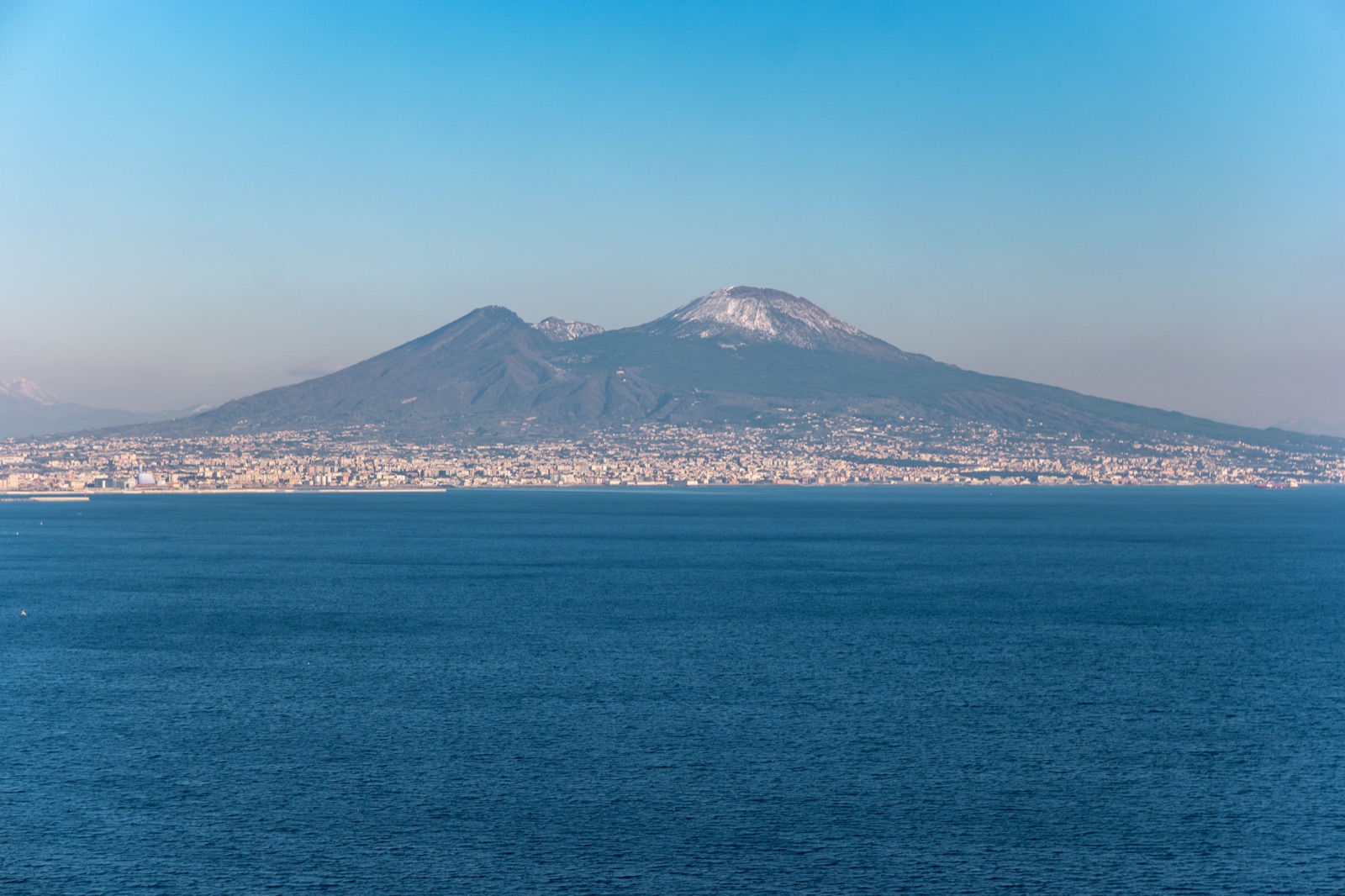
The point of the climb is the view: into a crater 450 m across and 300 m deep, with small fumaroles on the cone, and out over the Bay of Naples. How much of that you see depends far more on the day than on the month.
- Clear, dry days after a change in the weather give the longest views over the bay and the towns below. They can come in any season, including winter.
- Hazy summer days soften the panorama; the crater itself is still impressive, but the bay can fade into the haze.
- Cloud and mist sit on the summit on some days of every season. Walkers on the rim then see little beyond the railings, and if the wind rises the path may close.
The practical answer is to keep your plans flexible within your trip: if you have several days in the area, look at the forecast for the crater on the Vesuvius weather page and book the day that looks clearest, remembering that tickets cannot be changed once bought.
The rest of the park through the seasons
The crater is only one of the national park’s 11 trails, and the others have seasons of their own. See the hiking trails guide for the routes.
- Spring is the best time for the woods and lower slopes: wild orchids in the Tirone reserve and beside the lava-flow trail, orange lilies on Monte Somma, and broom in flower across the old lava.
- Summer brings the golden oriole to the orchards and vineyards on the eastern slopes of Monte Somma, but the long trails are hot work; start at dawn or choose the shaded pine woods of Tirone at the weekend.
- Autumn is good walking weather again, with dry paths and cooler days.
- Winter is quiet in the woods; in cold weather the coal tit comes down from higher up into the Terzigno pine wood, an easy level walk for any season.
Wherever you walk, the park asks you always to check the weather and to wear suitable shoes.
Booking by season
- July, August, Easter and holiday weekends: book as soon as the 30-day window opens for your date.
- April to June and September: book a week or more ahead, earlier for mid-morning slots.
- November to February: you will usually find a slot, but check the weather forecast before buying, because tickets cannot be changed or cancelled and only weather closures are refunded.
If you prefer not to juggle slots and transport, a transfer with the entry ticket included takes the booking off your hands. See the crater ticket guide for how the online system works.
Combining Vesuvius with Pompeii through the year
The ruins and the volcano keep different hours, so the order of the day depends on the season.
- 16 March to 14 October: Pompeii opens 9.00 to 19.00 with a last entrance at 17.30. Either order works; in summer the crater early and Pompeii later avoids the midday heat on the exposed path.
- 15 October to 15 March: Pompeii closes at 17:00 with a last entrance at 15:30, and the crater’s last entry is 15:00 or 16:00. Do one in the morning and the other straight after lunch, and allow for the transfer between them.
Pompeii is closed on 25 December and 1 January. Combined tours from Naples and Sorrento handle the timing for you; see the one-day guide.
What to wear by season
- Spring and autumn: layers, a windproof and walking shoes with grip for the loose volcanic gravel.
- Summer: a hat, sun cream, water and light clothes, but keep a layer: it is cooler and windier at 1,000 m than in Naples.
- Winter: warm layers, gloves and a hat, because it is colder at the crater than at the foot of the volcano.
The climb is not recommended for people with complex respiratory or cardiovascular conditions in any season.
Frequently asked questions
What is the best month to visit Vesuvius?
May and September are hard to beat: a last crater entry of 17:00, long days for adding Pompeii, and fewer people than in July and August.
Is Vesuvius open in winter?
Yes. The crater path opens at 9:00 with a last entry of 15:00 from November to February, but wind, rain, snow, ice or a weather alert can close it.
What time should I visit Vesuvius?
The first slots from 9:00 are the calmest and, in summer, the coolest. In July and August a late slot before the 18:00 last entry also works.
Can you visit Vesuvius at sunset?
Not on the crater path. Even in July and August the last entry is 18:00 and the visit must end within an hour of it.
Does the crater close in bad weather?
Yes. In strong wind, rain or snow, or during a civil protection weather alert, the path may close. Tickets are refunded only for closures due to bad weather or force majeure.