Vesuvius with Kids: The Crater Walk, Easy Trails and Accessibility
Yes, you can visit Vesuvius with children, and the crater walk is within reach of most children who are used to walking. The path from the square at 1,000 m above Ercolano is about 3,807 m in total, climbing about 140 m at an average 14% gradient on loose volcanic gravel, and the round trip is usually given as about 3 hours with stops. Children under 6 go free with an accompanying adult, and young people under 25 pay the reduced rate. For toddlers, pushchairs or visitors who cannot manage a steep gravel path, the national park has easier options: a level boardwalk in a pine wood at Terzigno, built for people with reduced mobility, and a one-hour walk onto the 1944 lava flow near the Osservatorio.
This guide covers what the crater walk is like for families, how children’s tickets work, the easier trails and museums, and how to plan a day that works for everyone.
The short answer
- Crater walk with kids: fine for most children who can walk a few kilometres uphill on gravel; graded medium.
- Tickets: under 6 free (booked online with a paying adult, with ID showing age); under 25 reduced at €8.00 before fees; full price €10.00 before fees.
- Free tickets need a paid one: up to 4 free tickets for each full or reduced ticket.
- No toilets at the start: the crater square temporarily has no public toilets.
- Easiest walks: trail 11 in the Terzigno pine wood (30 minutes, level) and trail 9, the Fiume di Lava (about 1 hour, graded low).
- Not recommended: the climb for anyone with complex respiratory or cardiovascular conditions.
Can children climb Vesuvius?
The crater visit follows trail 5 of the national park, the Gran Cono, from the square at Quota 1000 in Ercolano. The numbers that matter for families:
| What | Figure |
|---|---|
| Total length | about 3,807 m |
| Highest point | 1,170 m |
| Climb | about 140 m |
| Average gradient | 14% |
| Time there and back | about 3 hours |
| Difficulty | medium |
The park’s ticket rules set no minimum age, and under-6s go free. What decides it is whether your child is happy walking steadily uphill on loose ground for a good while, and coming back down the same way. Children who walk regularly tend to cope with breaks; very young children are likely to need carrying for part of the way.
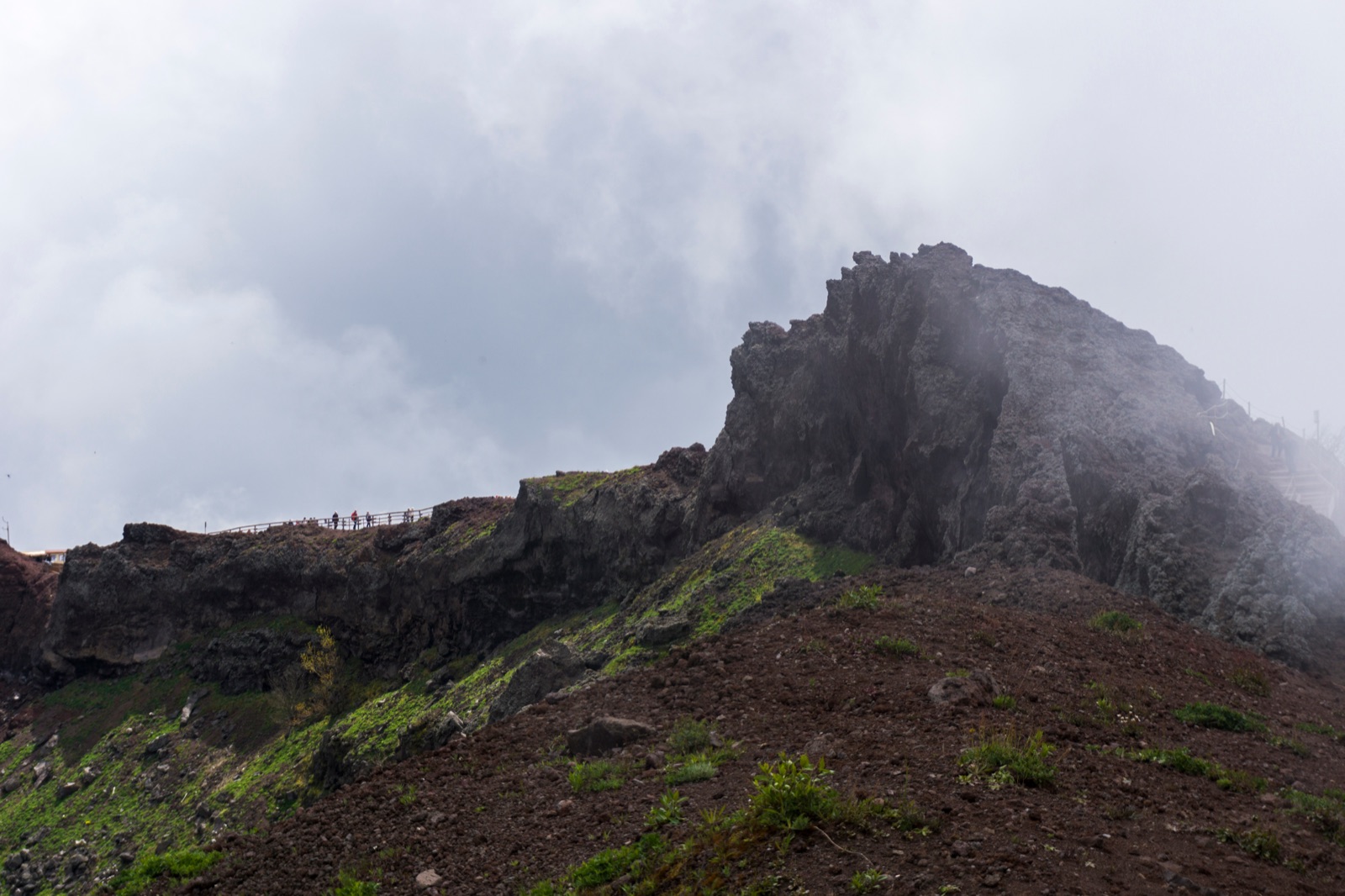
The rewards for kids are big ones: a real crater about 450 m across and 300 m deep, small fumaroles on the cone, and the whole Bay of Naples below. It is the most direct way to show a child what a volcano is.
Tickets for children and families
Crater tickets are sold only online, on the park’s ticket site, up to 30 days ahead. The family rules:
- Under 6: free, with an accompanying adult and an ID document showing the child’s age. The free ticket is booked online.
- Under 25: the reduced ticket, €8.00 before booking fees (€9.55 on the ticket site), with ID showing age.
- Adults: full ticket €10.00 before fees (€11.68 on the ticket site).
- Free tickets go with paid ones: you can book up to 4 free tickets for each full or reduced ticket, in the same order.
- Up to 10 tickets per email address per day of visit, which covers most families.
- School trips do not get the under-6 free ticket; schools book reduced tickets by email.
If you end up needing last-minute tickets, note that since 11 April 2026 they carry each visitor’s name, checked against an ID at the gate; children without ID are checked through the accompanying adult, and without an identifiable companion entry is refused. Bring the documents you used to book.
Full details of the booking system are in the crater ticket guide.
Making the crater walk work with kids
A few habits make the difference between a great half-day and a grumpy one:
- Book an early slot. Visits start at 9:00, the path is calmer then, and in summer it is cooler. You may enter up to 120 minutes before or after your ticket time, which absorbs a late bus.
- Use the toilets before you go up. The Quota 1000 square has no public toilets at present, and there is no parking on the square either; drivers park lower down and walk or take the shuttle.
- Pack water, snacks, hats and a warm layer. It is colder and windier at the crater than at the foot of the volcano, especially in autumn and winter, and the wind can rise suddenly.
- Wear proper shoes. Sandals and loose volcanic gravel do not mix.
- Keep to the path and the railings. The park asks everyone to stay on the marked paths.
- Turn around if you need to. The walk is out and back, so you can stop at any point.
Check the Vesuvius weather page before you set out: in strong wind, rain or snow the path may close, and tickets are refunded only for weather closures or force majeure.
Pushchairs and baby carriers
The crater path is a steep track on loose gravel, so a baby carrier or a sling is far more practical than a pushchair. A pushchair can be pushed up with effort, but it is hard work on the gradient and awkward on the way down.
If your party includes a pushchair, consider splitting up: one adult walks to the crater while the other takes the pushchair on the level Terzigno pine-wood boardwalk or to a museum, and you swap later in the day or on another day.
Easy trails for small children
The national park has 11 trails with 54 km of walkway, and two of them are ideal for young children.
Trail 11, La Pineta di Terzigno is the easiest walk on Vesuvius:
- 1,500 m return, about 30 minutes, graded low, reaching only 211 m.
- A level route in a dense pine wood, built by the park in 2004-2005 for easy walks and for people with reduced mobility.
- A wide wooden boardwalk with a rope handrail, panels with texts in braille and a “garden of scents” of Mediterranean plants.
Trail 9, Il Fiume di Lava is the park’s educational trail and especially suitable for school groups:
- 1,039 m return, about 1 hour, graded low, from Via Contrada Osservatorio in Ercolano.
- It passes a cutting where pumice from the AD 79 eruption shows in the walls, then ends on the 1944 lava flow, silvery grey with lichen, with a view of the bay.
- It starts near the Osservatorio Vesuviano, so it pairs with the observatory museum.
For older children who like a challenge, the longer routes are described in the hiking trails guide. Trail 4, through the Tirone reserve, is wide and mostly level but long (11,260 m return); it opens at weekends with park guides on the trail, and you can simply walk part of it and turn back.
Visitors with reduced mobility or disabilities
The crater path is not level and climbs steadily on gravel, so it is hard going for anyone who uses a wheelchair or has difficulty walking uphill. The park also says the climb is not recommended for people with complex respiratory or cardiovascular conditions.
What the park does offer:
- Free crater tickets for adults with a certified 100% disability, minors with a certified disability, and their companion. These are requested by email, not bought on the ordinary ticket page.
- Trail 11 at Terzigno, designed for people with reduced mobility and for blind and partially sighted visitors, with a boardwalk, a rope handrail and braille panels.
- The first stretch of trail 3 on Monte Somma, about 800 m of the old Via Traversa fitted out for blind visitors and people with reduced mobility, with a rope handrail and raised markers every 100 metres. Check with the park first, because a section of trail 3 is currently closed.
- The Osservatorio museum, where the visit involves some architectural barriers that staff can help with using a stair lift; mention it when you book.
At Pompeii, note that the Artebus shuttle linking the sites has room for large luggage but no disabled access.
Museums for families
When the weather closes the crater, or small legs have had enough, three museums around the volcano work well with children.
- The Osservatorio Vesuviano museum, the first volcano observatory in the world, founded in 1841. Visits are free, Monday to Friday, guided in Italian or English, in groups of 10 to 25 people, booked by email. Guided visits are currently open to lower and upper secondary schools, and a route for primary schools is being prepared, so for school groups it suits older children best.
- The Vesuvius National Park museum at Villa Regina in Boscoreale, with a model of the volcano and its eruptions and a model Vesuvian farmhouse. Open Friday to Sunday, 10:00 to 16:00, booking compulsory, at most 30 visitors per slot.
- The MAV in Ercolano, a virtual archaeology museum with more than seventy multimedia installations. A family ticket with the 5D film costs €30.00 for 2 adults and 2 children, plus €7.5 for each extra child; under-13s pay €8.00 on a single ticket. From 1 October to 28 February it is closed on Mondays.
There is more on all three in the national park guide.
Pompeii and Herculaneum with kids
Most families combine the volcano with one of the buried towns. The child-related rules:
- Herculaneum: visitors under 12 must be accompanied; young people aged 18 up to their 25th birthday pay €2. It is a compact site, which helps with children.
- Pompeii: EU citizens aged 18 to under 25 pay €2.00. Its thematic itineraries, Civic Pompeii and Daily Pompeii, take about 1.5 hours and cost €8.00 plus the entrance ticket, free for children under 10.
- Both are free on the first Sunday of every month.
Pompeii is big; with young children, choose a few streets and houses rather than trying to see everything. See Vesuvius and Pompeii in one day for the timing of a combined day, and the Herculaneum article for that site.
Three family plans
- Half-day, school-age kids: an early crater slot, back down by lunchtime, an afternoon at the hotel pool or the beach. A crater ticket and a bus or shuttle are all you need.
- Full day, older kids: crater in the morning, Herculaneum in the afternoon, which is smaller and easier to manage than Pompeii.
- Toddlers or a pushchair: the Terzigno boardwalk in the morning, the park museum at Boscoreale (Friday to Sunday) or the MAV after lunch, and the view of Vesuvius from the Naples waterfront in the evening.
Keeping children interested on the way up
The climb is short enough that a few things to look for keep most children going:
- The other volcano. Across the valley to the north rises Monte Somma, the remains of an older volcano. From the square you can already see its highest point, Punta Nasone, at 1,132 m. Ask them to spot the “volcano inside a volcano”.
- Steam on the cone. Small fumaroles on the Gran Cono are a sign that the volcano is in a state of active rest, not extinct.
- The crater itself. About 450 m across and 300 m deep: a good moment to talk about how big that is compared with something they know.
- The view. Naples, the bay, and on clear days the islands. From up here it is easy to see why so many people live around the volcano, and why Pompeii and Herculaneum were caught in AD 79.
- Rocks and plants. Grey lava, loose lapilli underfoot, and the silver lichen Stereocaulon vesuvianum on the 1944 lava flows. Look but do not take: collecting minerals or plants is not allowed.
For background to share on the way, the AD 79 eruption article and is Vesuvius still active? cover the questions children usually ask.
What to bring for a family crater walk
- Tickets and ID for everyone, including the documents that show children’s ages.
- Water for each person, and snacks; there are few facilities on the mountain.
- A warm layer and a windproof, even in summer.
- Hats and sun cream from spring to autumn.
- Closed shoes with grip for the gravel.
- A baby carrier rather than a pushchair for little ones.
- Wet wipes and a small bag for rubbish, because the park bans litter and there are no toilets on the square at present.
Getting there with children
Public transport works, but it means two legs: the Circumvesuviana to Pompei or Ercolano Scavi, then bus 808 from Pompeii (about 55-70 minutes, roughly every 60-120 minutes) or the Vesuvio Express shuttle from Ercolano. With small children, a door-to-door option can be worth it: a transfer from Pompeii or Naples with the entry ticket included removes the waiting and the booking. Drivers park at the Comune di Ercolano’s car parks between Quota 800 and the upper square, for €7 a car, and should buy the crater ticket before the parking ticket, because crater entry is capped. Full options are in getting to Vesuvius.
When to go with a family
- Spring and September give the best mix of long opening hours (last entry 17:00 from April to June and in September) and comfortable temperatures.
- Summer has the longest hours, with a last entry of 18:00, but the exposed path is hot in the middle of the day; go at 9:00.
- Winter is quiet, with a last entry of 15:00, but it can be cold and windy at the top, and closures are more likely.
See the best time to visit Vesuvius for the month-by-month picture.
Frequently asked questions
Can a 5-year-old climb Vesuvius?
It depends on the child: plan for breaks and some carrying. The path is about 3,807 m in total with a 140 m climb on loose gravel. Under-6s go free with an adult, so it costs nothing to try and turn back if needed.
Do children need a ticket for Vesuvius?
Yes, every visitor needs a ticket. Under-6s are free but must be booked online with at least one paid ticket, up to 4 free per paid one.
Can you take a pushchair up Vesuvius?
It is possible but hard work on the steep gravel path. A baby carrier is far easier.
Is Vesuvius wheelchair accessible?
The crater path is not suited to wheelchairs. The Terzigno pine-wood trail is a level boardwalk designed for people with reduced mobility, and disabled visitors and a companion can request free crater tickets by email.
Is there a toilet at the Vesuvius crater?
Not at present: the park says there are temporarily no public toilets on the Quota 1000 square.